
Evergreen Reference
Sauna Wood Types: The Definitive Comparison Guide
The permanent SŌLACE comparison resource for sauna buyers choosing between cedar, hemlock, basswood, aspen, and thermally modified spruce.
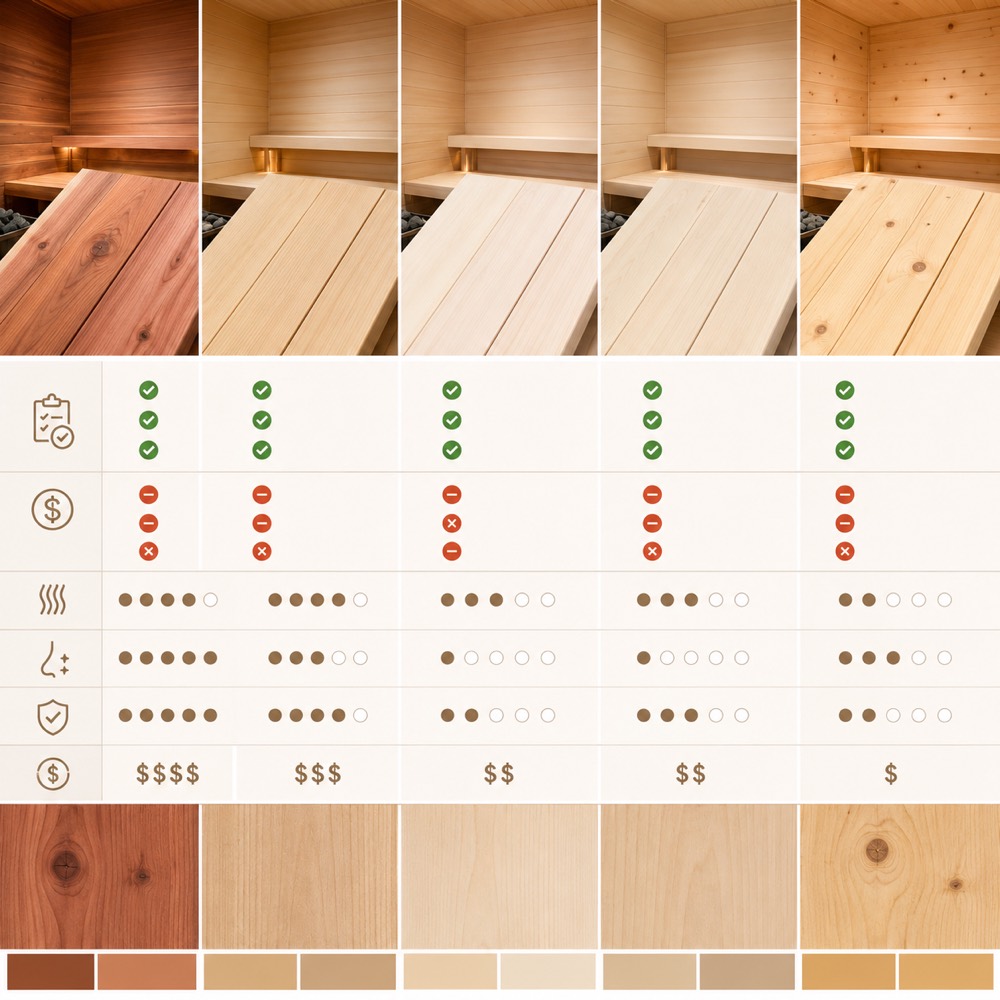
Choosing sauna wood determines durability, maintenance, surface comfort, aroma, indoor versus outdoor suitability, and the true lifetime cost of ownership.
This reference covers the five wood species that account for most residential sauna construction in North America: Western Red Cedar, Canadian Hemlock, Basswood, Aspen, and Nordic Spruce, including its thermally modified variant.
How To Use This Guide
Start with the master comparison table, then read the species profile for any wood you are seriously considering. If your sauna will live outdoors, pay special attention to moisture resistance and rot resistance. If you have scent sensitivities, start with the hypoallergenic column before looking at price.
The Master Comparison Table
| Property | Western Red Cedar | Canadian Hemlock | Basswood | Aspen | Thermo Nordic Spruce |
|---|---|---|---|---|---|
| Color | Rich reddish-brown | Creamy white to pale brown | Pale white to light tan | White to pale yellow | Pale cream to light gold |
| Aroma | Strong classic sauna smell | Minimal to none | None to faint sweet | None to very faint | None to very faint |
| Heat retention | Excellent | Good to very good | Moderate | Moderate | Very good to excellent |
| Surface temperature | Cool | Warm | Very cool | Very cool | Cool to moderately warm |
| Moisture resistance | Excellent | Moderate untreated | Poor | Moderate | Excellent when thermally modified |
| Rot resistance | Excellent | Moderate untreated | Poor | Moderate | Excellent when thermally modified |
| Hypoallergenic | No | Yes | Yes | Yes | Yes when thermally modified |
| Indoor use | Excellent | Excellent | Excellent | Excellent | Excellent |
| Outdoor use | Excellent | Only if modified | Not recommended | Not recommended | Excellent |
| Maintenance | Low | Moderate | Higher | Moderate | Low |
| Typical price | $8-$15 / sq ft | $5-$10 / sq ft | $4-$8 / sq ft | $4-$8 / sq ft | $7-$14 / sq ft |
| Best for | Outdoor and aromatic builds | Indoor and value builds | Allergy-sensitive infrared | Cool benches | Premium outdoor longevity |
Species Profiles
Western Red Cedar (Thuja plicata)
The classic aromatic sauna wood and the benchmark for natural outdoor durability.
Western Red Cedar ranges from pale amber to deep reddish-brown, with dramatic grain variation and natural knots that give each plank its own character. The color deepens with age and heat exposure, creating the warm visual tone most people associate with a traditional sauna.
Its defining feature is aroma. Cedar's volatile terpenes produce the warm, resinous scent that many sauna users consider essential. That same aroma is the reason cedar is not ideal for everyone: sensitive users, people with asthma, and buyers with chemical sensitivities should test cedar before committing.
Cedar's natural phenolic oils repel moisture, inhibit fungal growth, and help the wood tolerate rain, snow, UV exposure, and freeze-thaw cycling. A properly maintained cedar outdoor sauna can last 15-25 years, and sheltered installations can last longer.
Best applications: Outdoor barrel saunas, traditional builds, and buyers who want the full cedar sauna scent.
Pros
- Excellent natural rot and moisture resistance
- Authentic aromatic sauna experience
- Strong outdoor durability in all climates
- Low maintenance compared with most outdoor-suitable woods
Cons
- Premium price
- Aromatic oils can irritate sensitive users
- Natural color variation requires selection for uniform interiors
Canadian Hemlock (Tsuga canadensis)
The clean, versatile mid-range choice for indoor and infrared sauna construction.
Canadian Hemlock is pale, creamy, and visually quiet, with a fine grain and minimal knots. It creates a bright contemporary interior rather than the darker rustic warmth of cedar.
The aroma is minimal to none. Hemlock has very low resin content, produces no meaningful off-gassing at sauna temperatures, and is a strong choice for buyers who want a neutral cabin.
Untreated hemlock is only moderately moisture-resistant, so it depends on ventilation and maintenance. When thermally modified, hemlock and similar pale softwoods become dramatically more durable and approach cedar-level outdoor performance.
Best applications: Indoor traditional saunas, infrared cabins, scent-free installations, and value-conscious buyers.
Pros
- Functionally hypoallergenic
- Clean, modern appearance
- Lower cost than cedar
- Good heat distribution, especially in infrared cabins
Cons
- Untreated hemlock is not ideal outdoors
- No aromatic ritual for cedar purists
- Bench surfaces run warmer than aspen or basswood
Basswood (Tilia americana)
The hypoallergenic indoor specialist with the clearest maintenance caveat.
Basswood is nearly white to light tan, very uniform, and visually spa-like. It is one of the brightest woods used in sauna construction.
It contains no resins, tannins, aromatic oils, or meaningful volatile compounds. For users who require the most chemically neutral wood surface, basswood is the safest common sauna species.
The trade-off is durability. Basswood has poor moisture resistance, absorbs water readily, dents more easily than cedar or hemlock, and should never be used outdoors. Indoors, it requires thorough drying and good ventilation.
Best applications: Indoor infrared saunas and users with diagnosed scent or chemical sensitivities.
Pros
- Zero-fragrance, low-allergen profile
- Coolest bench surface of the common woods
- Bright, clean appearance
- Low upfront cost
Cons
- Poor moisture resistance
- Indoor-only
- Shorter lifespan and higher care burden
Aspen (Populus tremuloides)
A comfortable, hypoallergenic bench wood with better stability than basswood.
Aspen is pale white to light yellow with a clean, fine grain. It feels bright and modern but still reads as natural wood.
Its scent profile is minimal, making it a strong option for sensitive users. Thermally modified aspen removes even trace aromatic compounds and improves durability.
Aspen's main strength is contact comfort. It stays very cool to the touch and is one of the best bench materials available. SaunaLife uses thermally modified aspen for ERGO benches because it pairs comfort with outdoor-grade stability.
Best applications: Bench surfaces, backrests, sensitive users, and premium mixed-species construction.
Pros
- Hypoallergenic and comfortable
- Very cool bench surface
- Better stability than basswood
- Excellent when thermally modified
Cons
- Natural aspen is not outdoor-suitable
- Usually used as bench material, not full shell construction
- Less visually dramatic than cedar
Nordic Spruce, Thermally Modified (Picea abies)
The engineered performance choice and the strongest all-around sauna wood for longevity.
Natural Nordic Spruce is traditional in European sauna construction, but untreated spruce is not the right answer for exposed outdoor use. It needs either careful treatment or thermal modification.
Thermal modification changes the equation. Wood is heated in an oxygen-free kiln using heat and steam, removing sugars, resins, and moisture pathways that mold and bacteria exploit. The result is far more dimensionally stable, decay-resistant, and moisture-resistant than the natural species.
SaunaLife's ERGO barrel series uses 1.65-inch thermally modified Nordic spruce staves paired with thermally modified aspen benches. That mixed-species strategy is why the line can carry a limited lifetime warranty.
Best applications: Outdoor barrels, premium builds, low-maintenance ownership, and buyers optimizing for total lifespan.
Pros
- Best all-around performance profile
- Excellent outdoor moisture and rot resistance
- No cedar aroma or resin sensitivity issue
- Low maintenance and warranty-backed longevity
Cons
- Premium price compared with untreated wood
- No classic cedar aroma
- Less available for custom builds than cedar
Property Deep-Dives
Heat Retention: Ranked
- Thermally modified spruce: the best overall stability and insulation profile.
- Western Red Cedar: excellent natural insulation from its cellular air pockets.
- Canadian Hemlock: good, consistent heat distribution.
- Aspen: moderate heat retention with excellent contact comfort.
- Basswood: lower thermal mass, best suited to indoor infrared conditions.
Surface Temperature: Coolest To Warmest
- Basswood
- Aspen and thermally modified aspen
- Western Red Cedar
- Thermally modified spruce
- Canadian Hemlock
Bench comfort is a separate question from wall durability. That is why premium builds often use durable structural woods for the shell and cooler aspen or basswood for benches and backrests.
Durability and Lifespan
| Wood | Indoor lifespan | Outdoor lifespan | Key limiting factor |
|---|---|---|---|
| Thermally modified spruce | Lifetime warranty-backed | Lifetime warranty-backed | Normal wear only |
| Western Red Cedar | 20-30+ years | 15-25 years | UV exposure and physical wear |
| Canadian Hemlock | 10-15 years untreated | 5-8 years untreated | Moisture without natural oils |
| Aspen | 12-16 years | Not recommended | Moisture absorption |
| Basswood | 8-12 years | Not recommended | Moisture absorption and low density |
| Natural Nordic Spruce | 8-12 years | 3-7 years untreated | Resin and moisture |
Aroma Profile
| Wood | Aroma intensity | Aromatic compounds | Sensitivity risk |
|---|---|---|---|
| Western Red Cedar | Very strong | Cedrol, cedrene, alpha-cedrene | Moderate for sensitive users |
| Natural Nordic Spruce | Mild to moderate | Pine resins, grade-dependent | Low to moderate |
| Canadian Hemlock | Minimal | Very low resin content | Very low |
| Aspen | Minimal | Trace wood scent | Very low |
| Basswood | None | No measurable aromatic oils | Very low |
| Thermally modified spruce / aspen | None to trace | Resins removed by kiln process | Very low |
True Cost of Ownership
| Wood | Price / sq ft | Annual maintenance | Outdoor lifespan | 20-year cost index |
|---|---|---|---|---|
| Thermally modified spruce | $7-$14 | Very low | Lifetime | Lowest over 20 years |
| Western Red Cedar | $8-$15 | Low | 15-25 years outdoors | Low |
| Canadian Hemlock untreated | $5-$10 | Moderate | 5-8 years outdoors | Moderate |
| Aspen | $4-$8 | Moderate | Indoor only | Indoor-specific |
| Basswood | $4-$8 | Higher | Indoor only | Indoor-specific |
| Natural Nordic Spruce | $3-$7 | Higher outdoors | 3-7 years outdoors | High if used outside |
Mixed-Species Construction
The best sauna builds often use different woods for different jobs. Shell and structural staves should prioritize weather resistance and dimensional stability. Benches and backrests should prioritize cool surface temperature and allergen safety.
SaunaLife's ERGO series follows this logic: thermally modified spruce for the barrel body and thermally modified aspen for benches. That combination delivers outdoor durability, comfortable seating, low aroma, and warranty-backed longevity.
The Decision Framework
If your sauna will live outdoors year-round: choose thermally modified spruce or Western Red Cedar.
If you want the classic aromatic sauna experience: choose cedar.
If you have scent sensitivities: choose thermally modified spruce with thermo-aspen benches, basswood, or aspen.
If you are buying an indoor infrared sauna: hemlock, basswood, and aspen are all appropriate depending on your sensitivity and budget.
If you want the lowest lifetime cost: choose thermally modified spruce with a strong warranty.
Woods To Avoid In Sauna Construction
| Wood or material | Why to avoid it |
|---|---|
| Pine | High resin content can drip and off-gas at sauna temperatures. |
| Pressure-treated lumber | Preservative chemicals are unsafe when heated in an enclosed sauna. |
| MDF or composite panels | Binders and resins can off-gas and moisture can cause delamination. |
| Fir and Douglas Fir | High resin content makes them poor sauna interior choices. |
| Teak | Excellent outdoors generally, but not appropriate for heated sauna interiors. |
Frequently Asked Questions
What is the best wood for a sauna overall?
For outdoor use and maximum longevity, thermally modified Nordic spruce is the strongest all-around performer. For the traditional aromatic experience, Western Red Cedar is unmatched. For allergy-sensitive indoor applications, basswood or thermally modified aspen is safest.
Is cedar or hemlock better for a sauna?
Cedar is better outdoors because of its natural rot resistance. Hemlock is often better indoors for buyers who want a lower-cost, scent-free environment.
Is thermally modified wood worth the premium?
Yes for outdoor installations and long-term ownership. Thermal modification improves moisture resistance, dimensional stability, rot resistance, and resin removal without chemical preservatives.
Can I mix different wood types in one sauna?
Yes. A durable shell with cooler bench material is often the best design. Thermo-spruce plus thermo-aspen is the cleanest example of that strategy.
Does sauna wood need to be sealed?
Cedar and thermally modified species generally do not need sealant. Untreated hemlock, basswood, aspen, and natural spruce need more careful drying, ventilation, and periodic maintenance.
Recommended Products By Wood Type
Western Red Cedar: Dundalk Harmony Outdoor Barrel Sauna and Dundalk Serenity with Porch.
Thermally modified Nordic spruce with thermo-aspen benches: SaunaLife ERGO E6, SaunaLife ERGO E7, SaunaLife ERGO E7G, SaunaLife EE6G, SaunaLife ERGO E8, and SaunaLife XPERIENCE X6.
Hemlock, basswood, and indoor options: browse the indoor sauna collection.
Explore the complete SŌLACE Ritual collection.
Related reference: complete sauna temperature guide by health goal.
SŌLACE Ritual is an independent thermal wellness resource. We may earn a commission when you purchase through links on our site at no additional cost to you. This reference page is maintained by SŌLACE Ritual and updated annually as new products and research become available. Product availability and pricing are subject to change.